DocumentaciónAnonimización
Diccionario personal
En el diccionario decides qué términos se anonimizan siempre y cuáles nunca. Las listas aplican automáticamente en cada chat y documento.
4 Min
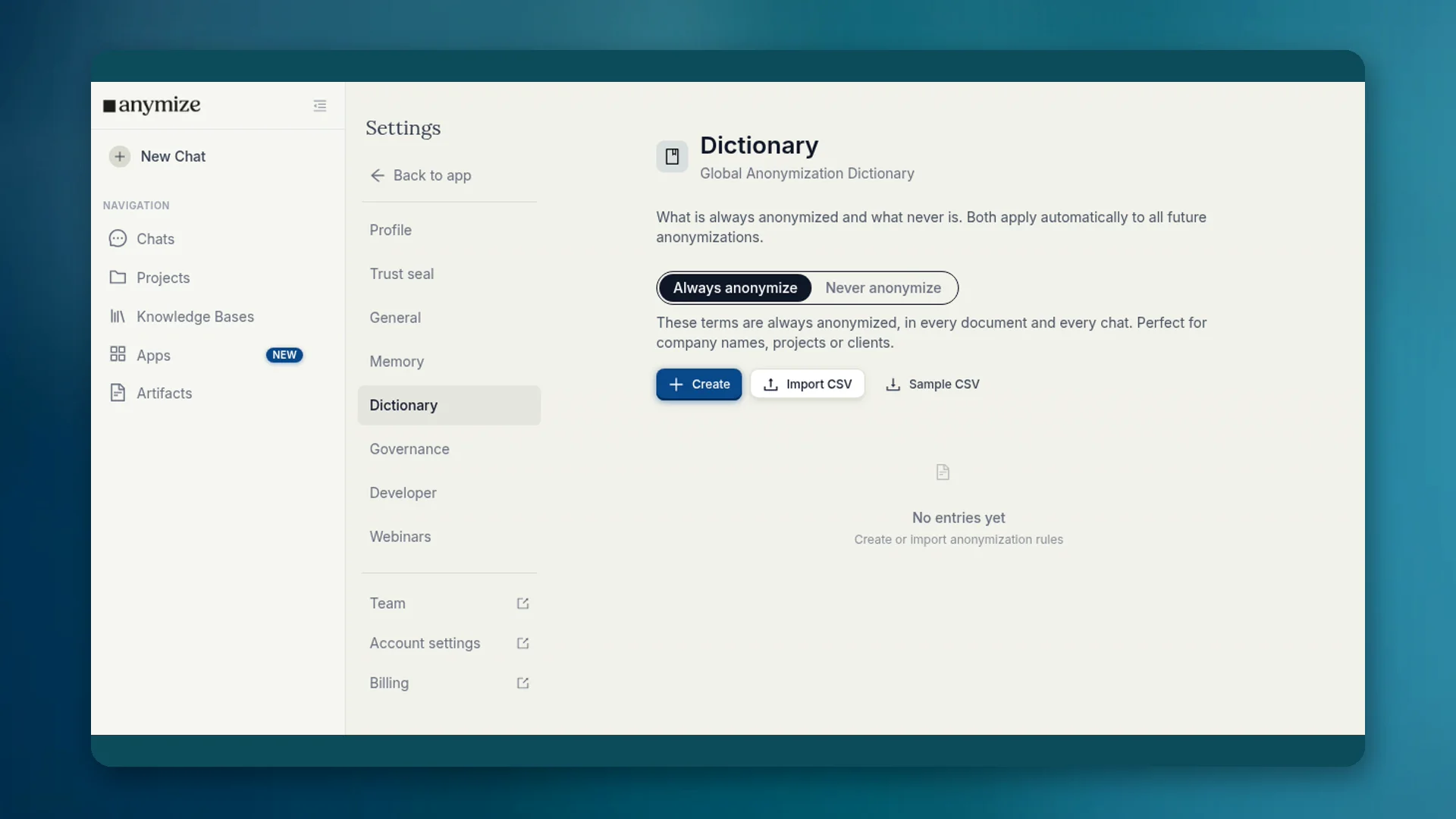
Para qué sirve el diccionario
Detection does not know your in-house terms. A project name may stay in clear text even when it is sensitive. Your firm name may become a placeholder and make answers hard to read. The dictionary corrects both permanently.
Dónde encontrarlo
- Apps → Dictionary: the same UI in the apps area.
- Settings → Dictionary: global anonymization dictionary in the account.
- Governance Center → Dictionary: team entries for admins (see separate article).
Apps and Settings show your lists. Team-wide entries for all members are managed by owners and admins in the Governance dictionary.
Siempre y Nunca
| List | Example | Effect |
|---|---|---|
| Always anonymize | Client name, internal project, codename | Becomes a placeholder in every document and chat |
| Never anonymize | Your firm name, product name, specialist term | Stays in clear text and reaches the model unchanged |
Create entries with Create or import CSV. For Always anonymize you also pick the placeholder category (person, organization, place and more).
Personal y Governance
Your personal dictionary applies to you. Team entries apply to everyone and may only be set by owners and admins, because they change anonymization for the whole team. Details and the Block team dictionary rule are under Governance → Dictionary.
Short version: fine-tuning for you here. Binding house rules in the Governance dictionary.
Casos típicos
- Your company name wrongly detected as an organization → Never anonymize.
- Client codename detection misses → Always anonymize.
- Tax-law term that looks like a name → Never anonymize.